In fall 2022, Center for Health Progress (CHP) and the Collaborative on Media and Messaging (COMM HSP) jointly launched a community-based participatory research project to explore how grassroots narrative power can disrupt deeply entrenched myths about the U.S. healthcare system and motivate collective action toward transformation. Below, we summarize the results of our two-year collaboration, published in The Milbank Quarterly.
Background
The COMM HSP team was founded with a clear purpose: to track how media narratives on topics relevant to racial justice and health equity impact communities most harmed by inequitable structures, through shaping public opinion and policy perceptions. From the beginning, we were clear that we must look beyond the halls of academia to learn how we can do this. We needed imaginative partnerships with community-based organizations that would challenge us to think creatively about research questions that are rapidly responsive to the needs of practitioners on the frontlines. Organizations like CHP (a people-powered, multi-racial, member-led organization in Colorado) organize working-class communities to challenge inequitable structures of the healthcare system that put corporate profit over the wellbeing of ordinary people.
The study
Building narrative power is a foundational strategy used in community organizing. It involves both dismantling dominant narratives that uphold inequity and constructing counternarratives that advance health and racial justice by reshaping how people make sense of the world. Unfortunately, the pathways through which narrative power can influence public attitudes (and ultimately health policy change) are rarely evaluated with empirical research.
Over the course of two years, our core study team of COMM HSP researchers and CHP organizers designed a unique three-phase study to explore how narrative power can disrupt deeply entrenched myths about the U.S. healthcare system – and motivate people to take collective action to change it. But rather than relying on traditional message-testing methods, our team took a different approach. We began by building relationships between the research team and CHP staff and organizers/community leaders, to ensure our project remained anchored in CHP’s vision to develop member-led narrative frameworks about health equity and healthcare. As outlined in the article, this collaboration shaped each stage of our project:
- Centering CHP voices. Using a co-created interview guide, we conducted interviews with 7 community leaders on CHP’s narrative organizing committee, to surface their reflections on the healthcare system – with attention to how soaring costs and complexity have impacted the wellbeing of their families and communities.
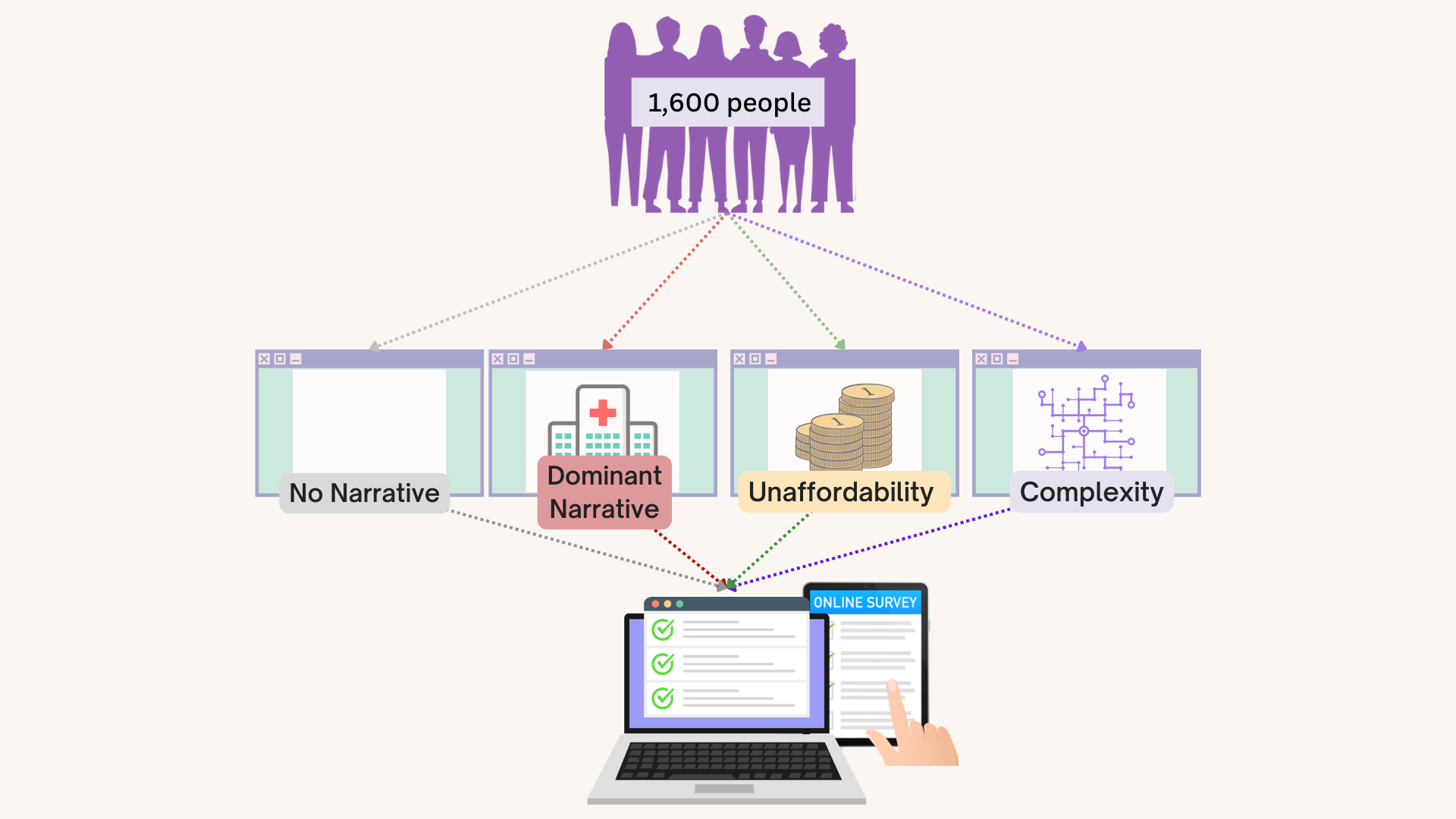
- Co-designing counternarratives. Pairing the wisdom of CHP leaders shared in interviews with the foundational principles of the Race-Class Narrative (RCN) framework used often in organizing practice, we co-designed two distinct counternarratives – one focused on healthcare unaffordability and the other on system complexity – to test against a constructed “dominant narrative.” The dominant narrative was based on a review of health care corporate communication and was grounded in CHP leaders’ perspectives on the prevailing narratives about healthcare most harmful to their community.
- Testing what matters. Finally, we built a survey experiment to test the effects of these counternarratives (vs. the dominant narrative) on outcomes that truly matter to organizers: for example, whether counternarratives can shift public perceptions of blame for poor outcomes, and inspire people to take collective action to fix the system. See Figure 1 for a schemata of the randomized experiment study design.
Figure 1
Key findings
Dominant narratives suppress action intentions. Affirming what organizers know and see in their everyday lives, we found that exposure to dominant narratives that “individualize” blame for poor health dampened participants’ motivation to engage in social justice behaviors or collective action.
Counternarratives shift blame attributions. In our survey, exposure to counternarratives generated by CHP leaders successfully increased participants’ perception of blame attributed to powerful institutions, including the medical industry and the federal government (see Figure 2).
Figure 2
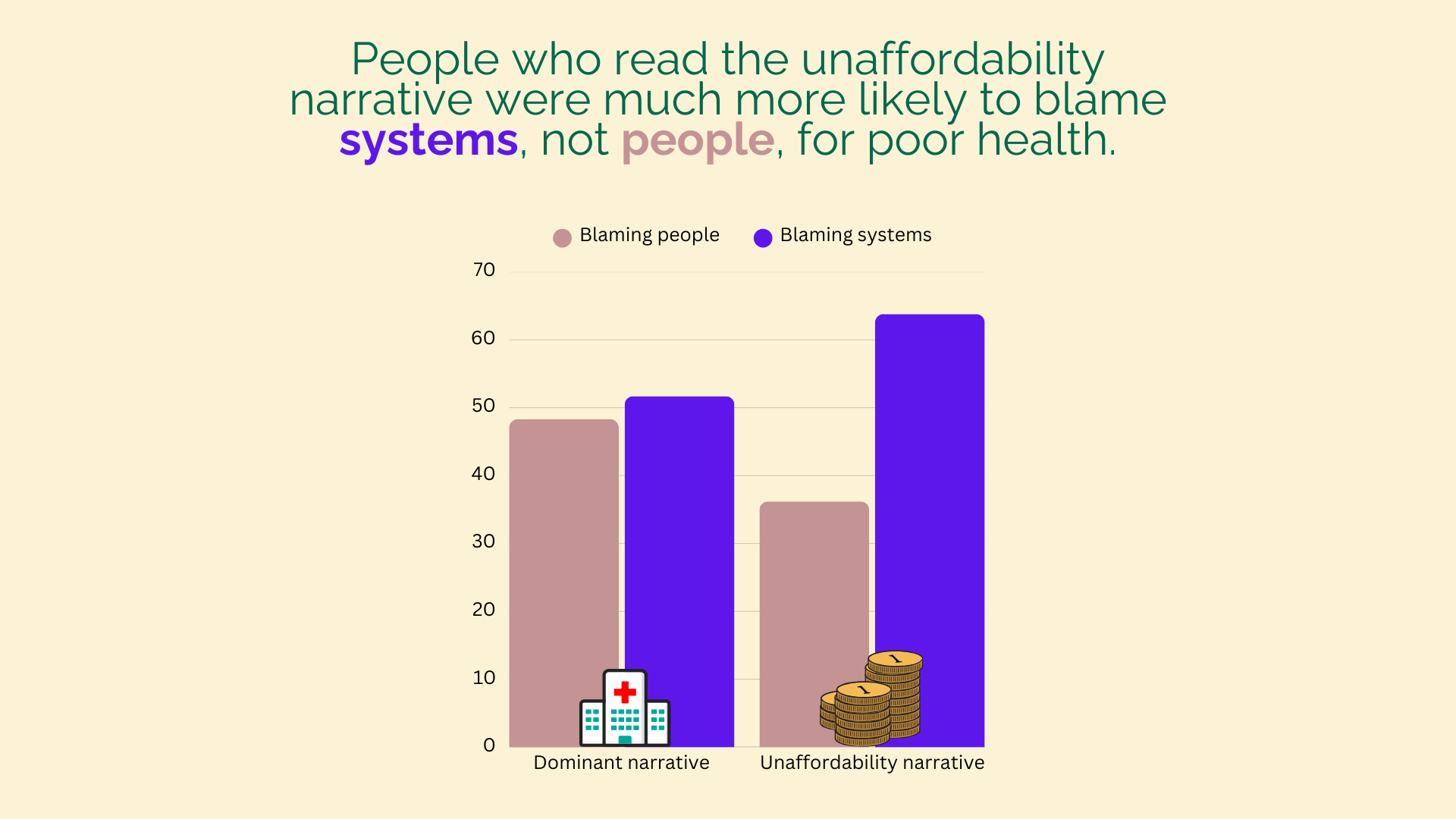
Potential working-class mobilization: The unaffordability counternarrative was particularly potent for survey participants earning below the national median income, suggesting that such narratives may help build the working-class power needed to usher in healthcare system transformation.
Bipartisan resonance: Notably, despite a deeply polarized political climate concerning health policy, these narrative shifts occurred across the board. The narratives grounded in the lived experience of organizers resonated with Democrats, Republicans, and Independents alike.
Implications / importance
In our partnership, we leveraged a research framework to test what community organizers do so effectively – expose how dominant narratives in a particular policy arena (such as health care) may constrain political possibilities, and seed resonant counternarratives that can mobilize coalitions and create opportunities for political change.
The findings from this project – particularly those related to shifting blame attributions, which is an important part of strengthening analysis of the healthcare system and in leadership development – were immediately put into practice among CHP organizers. In one-to-ones (relational conversations designed to help identify one’s personal stake, values, and inclinations to organize), CHP organizers are more intentionally looking for indicators that people attribute their challenges to structural problems. This has become an important metric in evaluating CHP leaders’ development as they progress through the organization. Organizers also integrate these learnings in other relational tools, such as agitational conversations that support people to move beyond internalized beliefs.
Beyond the findings outlined above and in the full manuscript, we also offer a partnership model for health researchers and community organizers to consider. Organizers are key partners in pursuing empirical research to inform narrative strategy. Through these collaborations, researchers can deepen their research questions and anchor their methodology in the experience and stories of people most impacted by the harms of the health system. Importantly, by partnering with power-building organizations, health researchers can pursue projects that are truly responsive to people’s material conditions. In today’s rapidly shifting federal landscape – as public health research dedicated to health equity faces mounting political threats – building deep, relational alliances with community organizers offers a critical pathway for mutual support for continuing and deepening health justice work.
Read more related work from the COMM team:
- On building narrative infrastructure for health and racial equity
- On the importance of dreaming about and mobilizing to create equitable futures
- On centering historically minoritized populations in messages about policy to advance equity
- A review of strategic messaging approaches to promote policies that advance racial equity
This research was funded by the Robert Wood Johnson Foundation (Grant no. 79754). The views expressed here do not necessarily reflect the views of the foundation.